Meticulous work at the loom – and precision woodworking in miniature – both play a role in recreating parts of the remarkable Oseberg tapestry.
By Einar Chr. Erlingsen
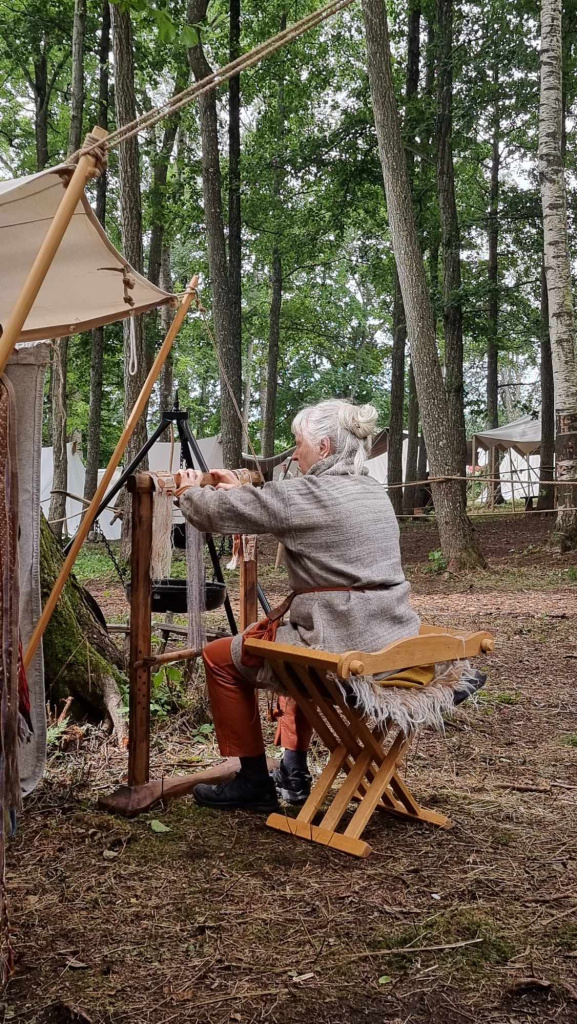
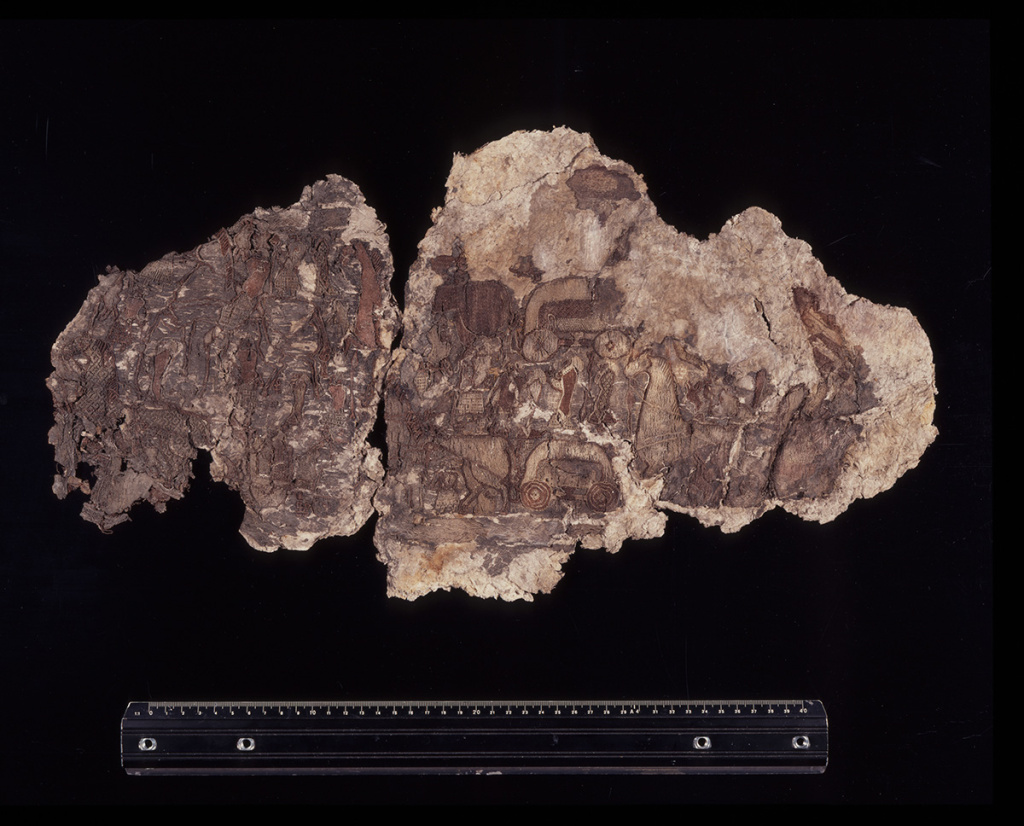
Among the many treasures from the Oseberg burial, the textiles rank among the most extraordinary. At the same time, they remain among the least studied in terms of how they were actually woven. The surviving tapestry fragments offer glimpses into a mysterious and mythological world that was barely recognised when the burial was excavated in 1904.
At the time, archaeologists concentrated mainly on preserving and documenting the many objects made of wood and metal. Even so, the young scientific illustrator Sofie Krafft made a remarkable contribution from 1907 onwards, carefully drawing both textiles and artefacts and recording colours wherever traces remained. Her work has since become an invaluable source for researchers seeking to understand the weaving techniques used in both the tapestry fragments and the many tablet-woven bands from the grave.
(Photo: Eirik Irgen Johnsen)
The foundation Oseberg Viking Heritage aims not only to build archaeological replicas of Vestfold’s Viking ships, but also to recreate other artefacts from the find – including textiles. The project draws on the expertise of a number of highly skilled craftspeople.

(Photo: Bente Skogsaas)
One of them is Bente Skogsaas, who has written a dissertation on the tablet-woven bands from the Oseberg find. She recently received confirmation from the University of Oslo that her dissertation has been accepted as the basis for a public defence for the degree of dr. philos.
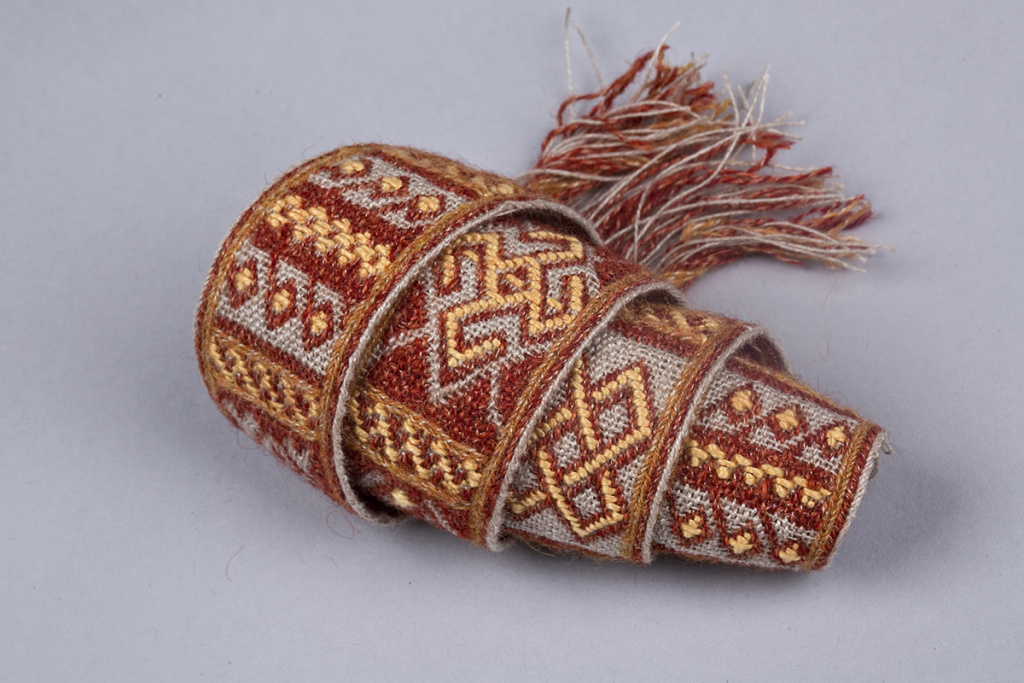
“My interest began when I attended an introductory course in tablet weaving in 2014,” Bente recalls. “During the course I saw an old watercolour of one of the bands from the Oseberg find, labelled 34D. I immediately felt I wanted to try weaving it myself.” The project eventually became her master’s thesis in Traditional Arts.
(Photo: Bente Skogsaas)
(Photo: Bente Skogsaas)
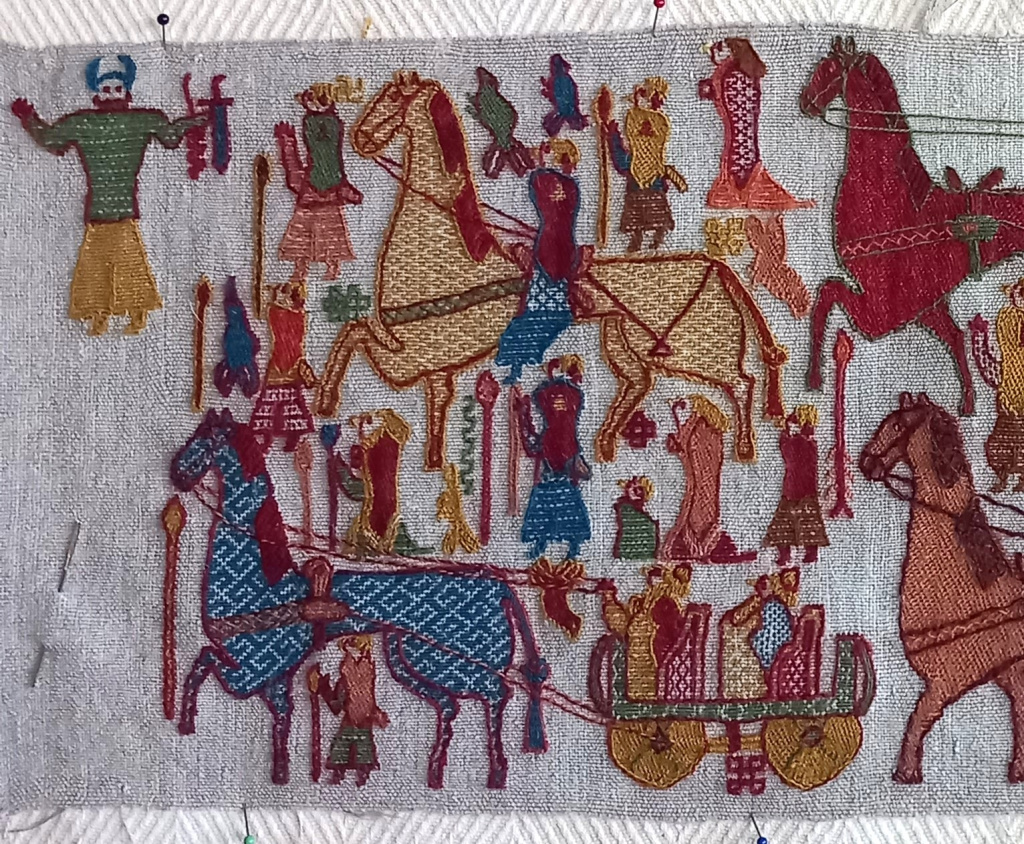
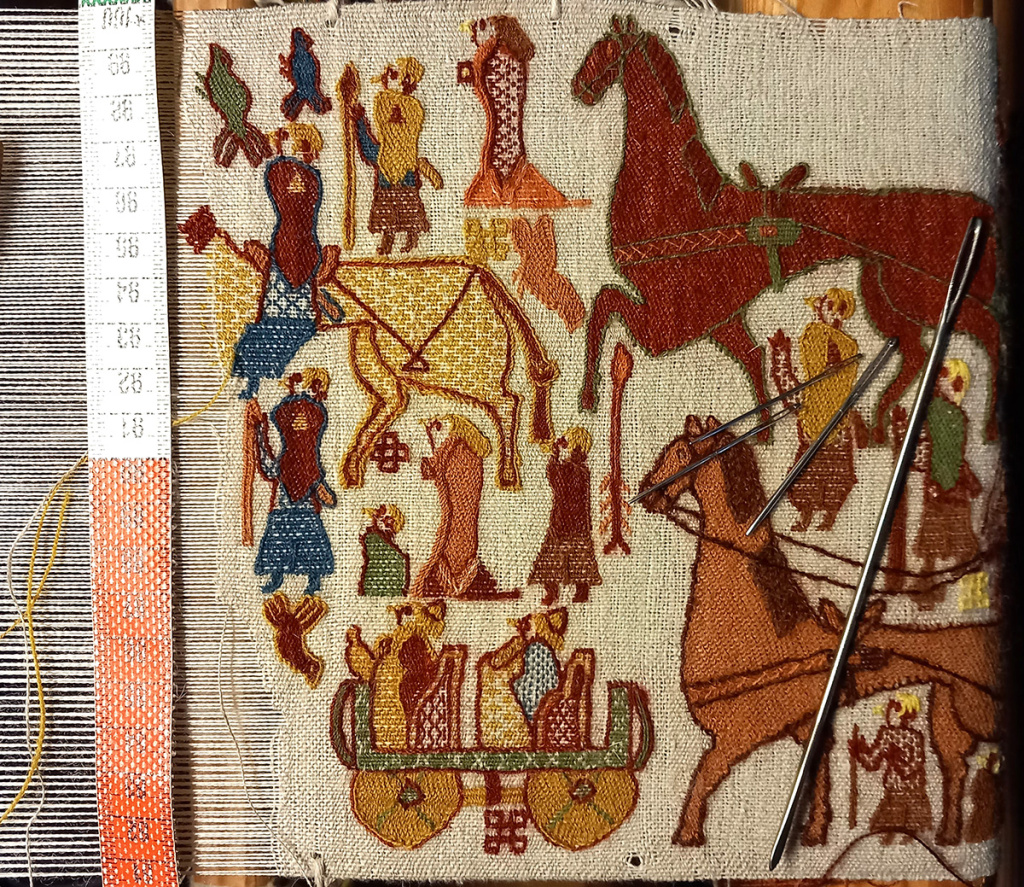
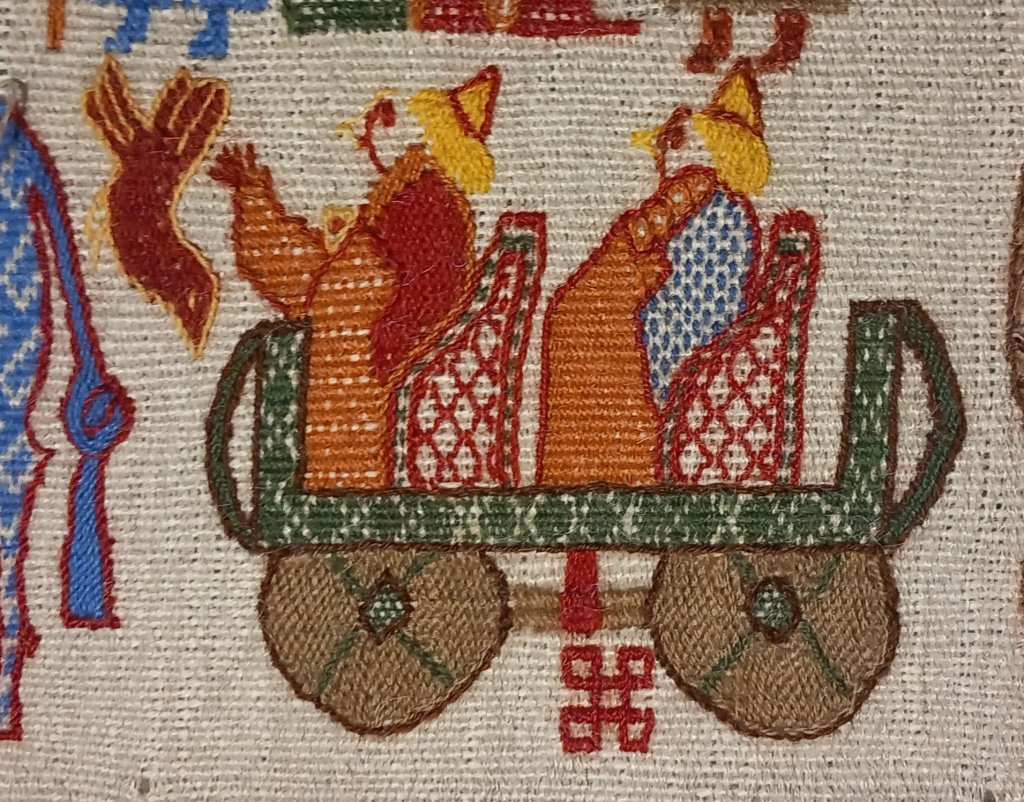
In the years since, she has painstakingly reconstructed several of the tablet-woven bands from Oseberg. She has now embarked on an even more ambitious undertaking: recreating tapestry fragments 1 and 2 of the so-called “Wagon Procession”, depicting a sequence of men and women, horses, birds and wagons.
A Tool Recreated
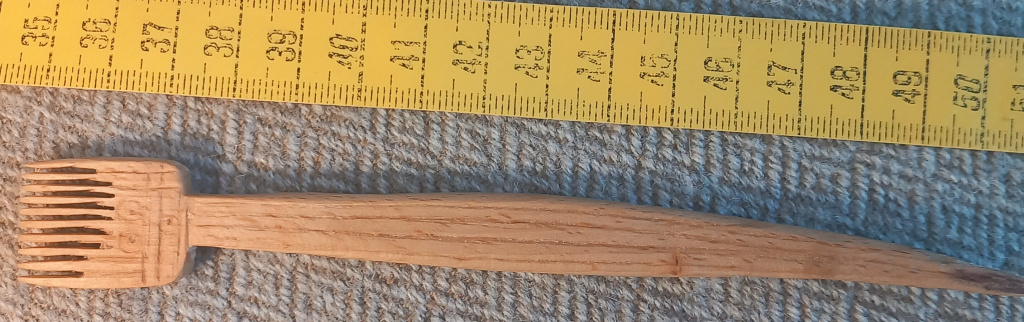
A small weaving fork was discovered in the Oseberg grave. Bente has been able to test the tool using an exact replica made by Bård Kjølsrød, one of the permanent boatbuilders at Oseberg Viking Heritage.
The original section of tapestry shown here (Wagon Procession 1–2) measures only 19 × 45 cm, excluding the tablet-woven borders above and below. Even so, it has required almost half a year of intermittent work at the loom.
The explanation lies in the extraordinary level of detail: up to 10–12 threads per centimetre – reflected in the spacing of the teeth on the weaving fork (10 per 2 cm). The yarn is hand-spun and dyed with plant-based dyes, just as in the Viking Age.
The sheer amount of work involved also suggests that the tapestry cannot have been produced specifically for the burial of the two Oseberg women. It must have been older – and originally far longer than the section reconstructed so far.
(Photo: Bente Skogsaas)
“I would also like to thank the Museum of Cultural History at the University of Oslo,” Bente adds. “They have been extremely helpful, giving me access both to the original material and to a large number of very high-resolution photographs.”
She now looks forward to the completion of the new workshop building at Vikingodden.
“Once it is ready, I would very much like to continue my work there – and to do it in full view of the public. For me, the most important aim is to share the remarkable craft heritage preserved in the Oseberg find.”
(Photo: Bente Skogsaas)

